
News
Refuge from mental health issues

Nov
Over 1 billion people globally are living with a mental health disorder, according to the World Health Organisation (WHO). Long-term studies reveal that global cases of anxiety, depression, PTSD and chronic stress have risen significantly over the last few decades.1
This rise is driven by a complex mix of technological, environmental, and societal factors, including:
1. Digital and Social Media Shifts
- The “Phone-based lifestyle”: Since the early 2010s, society has transitioned toward a high-screen-time lifestyle. This has been linked to rising anxiety and depression, particularly in adolescents and young adults.2
- Hyper-Comparison: Social media often encourages constant, unrealistic comparisons with others, fueling feelings of inadequacy, loneliness, and social isolation.3
- “Doomscrolling”: Constant access to negative global news (e.g., conflicts, economic downturns, and natural disasters) keeps the brain’s threat-detection system chronically active.4
2. Macro-Environmental Stressors
- Economic instability: living costs, housing unaffordability, and job insecurity drive up chronic financial stress.5
- Global and climate anxiety: geopolitical tensions, global conflicts, and climate change contribute to uncertainty, helplessness and worry.6
3. Societal and lifestyle changes
- The loneliness epidemic: Despite being digitally connected, modern social structures have led to higher rates of objective loneliness and a decline in traditional, in-person community support networks.7
- Sleep deprivation & burnout: Workplace demands and digital connectivity have eroded the boundaries between work and rest, affecting sleep quality and thus reducing the body’s natural resilience to stress.8
4. The Enduring Consequences of the Pandemic
- The COVID-19 pandemic triggered a massive 25% to 27% baseline spike in global anxiety and depression rates. Acute panic has since subsided; nevertheless, population-wide mental health metrics have remained elevated above pre-pandemic baselines due to prolonged social fragmentation and collective trauma.9
5. Increased Awareness and Diagnosis
- Destigmatisation: More people now recognise the symptoms of psychological distress, are willing to talk about them, and are actively seeking formal clinical diagnoses rather than suffering in silence.10
This is the world we are living in:
“… men’s hearts failing them, and for looking after those things coming on the earth” (Luke 21:26).
Mental health and believers
And Believers are not exempt. The number of brothers and sisters and young people suffering from mental health issues is also on the increase. The old assumptive argument that a person who suffers such symptoms lacks faith and doesn’t trust God has been found wanting. Many of these symptoms are shared by some famous Bible characters: Moses, David, Jeremiah, Barak, and Jonah are just a few. Even the Lord Jesus Christ suffered the symptoms of anxiety in the garden:
“…and (he) began to be sore amazed, and to be very heavy; And saith unto them, My soul is exceeding sorrowful unto death: tarry ye here, and watch.” (Mark 14:33–34)
The Lord was provided with practical and spiritual assistance (Luke 22:43), but even then it caused him even greater “agony”, and he prayed even “more earnestly; and his sweat was as it were great drops of blood falling down to the ground” (Mark 14:44).
What we need is practical as well as spiritual help in dealing with mental health issues, for both the sufferer and those who support. Understanding the issues goes a long way towards recovery.
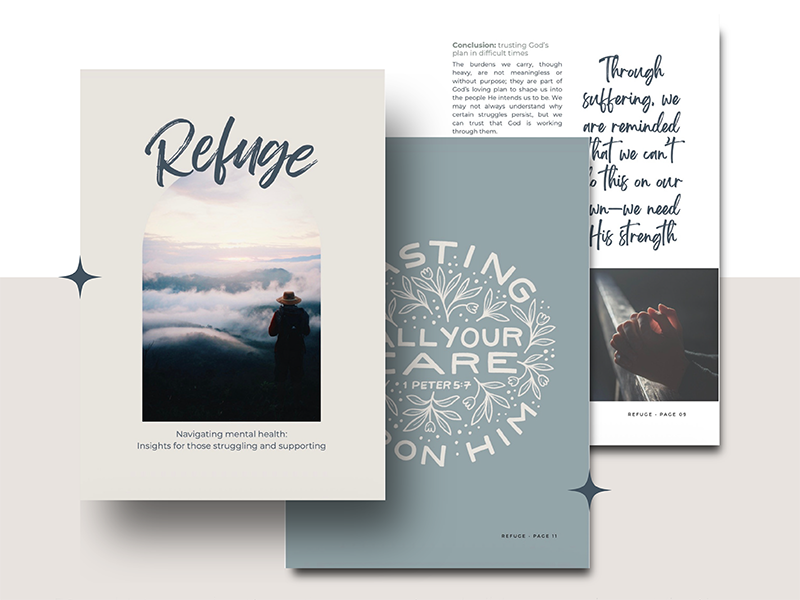
The Refuge Project resource:

Around 20 people have contributed towards this resource for those walking through mental health struggles, and for those supporting someone they love.
Within its pages are honest personal stories, biblical exposition, Godly wisdom, calming imagery, verse art, songs, practical reflection, and helpful guidance—all pointing back to the reassurance of God’s steadfast presence and grace.
“God is our refuge and strength, a very present help in trouble!” — Psalm 46:1
From the welcome page…
“Within these pages, you will find wisdom and experiences from those in our brotherhood who have walked this path before (and many who are still walking it). Their voices, alongside biblical encouragement and exposition, remind us that healing is possible, support is essential, and that struggling with mental health is not a sign of weak faith—faith can exist even in the midst of our mortal struggles. God never asks us to face these battles alone. He is “our very present help in times of trouble”, and He works through the support of others, the wisdom found in His Word, and the right tools for healing.
This is a resource well worth having on hand.
Footnotes:
1 E.g. National Library of Medicine: Epidemiological trends of depression and anxiety
2 Anxiety Centre: Why Are Anxiety And Depression Rates Rising?
3 ACC Institute of Human Services: The Rising Tide of Anxiety Disorders in Modern Society
4 ACC Institute of Human Services: The Rising Tide of Anxiety Disorders in Modern Society
Anxiety Centre: Why Are Anxiety And Depression Rates Rising?
5 National Library of Medicine: Trauma, Stress, and Mental Health Outcomes
6 ACC Institute of Human Services: The Rising Tide of Anxiety Disorders in Modern Society
7 Harvard: What is Causing Our Epidemic of Loneliness and How Can We Fix It?
The US Surgeon General’s Advisory: Our Epidemic of Loneliness and Isolation (PDF)
Radio NZ: Is there really a global loneliness epidemic? Research reveals a more complex picture
8 National Library of Medicine: Trauma, Stress, and Mental Health Outcomes
https://www.anxietycentre.com/articles/anxiety-depression-rates-rising/
9 WHO: COVID-19 pandemic triggers 25% increase in prevalence of anxiety and depression worldwide
Psychologoy Today: Depression and Anxiety Are on the Rise Globally
Medical Dialogues: Global Mental Disorders Continue Rising as Cases Reach Nearly 1.2 Billion Worldwide: Study (YouTube)
10 Rula’s 2026 report reveals critical mental health trends
Image acknowledgements:
Feature image (edited) by Kat Love on Unsplash
Refuge book cover by the Refuge Project