
What place should AI have in the life of a disciple?
2. AI’s algorithm and the Bible
Dec
This is the second in a series of articles on What place should AI have in the life of a disciple, by Ben Pitcher
“My ways are higher than your ways and my thoughts than your thoughts.” Isaiah 55:9
I used to be puzzled by John’s first epistle abruptly ending with a warning about idolatry. Idol worship seems such a “primitive” issue. Yet, in mankind’s technological tower of Babel, we can already observe almost every pedestrian walking head down in obeisance to man-made objects of precious metals and absorbed in the glowing information displayed on its screen.
If we spend excessive time listening and talking to an object of man’s making that displaces the time we would have otherwise been listening to God’s Word, or talking to Him in prayer, that’s idolatry.
Our previous article showed that AI is based on human thinking. We considered some of its dangers, particularly for the vulnerable. In this article, we wish to show its dangers in its use for Bible study, and the effects it could have on our vulnerable ecclesias.
A list of things to be aware of
Here are the key things we should be aware of in using AI tools, and how it could affect our spiritual lives, particularly in Bible study:
Bible presentations
Bible presentations should never be primarily about finding “some new thing” in an Athenian way (Acts 17v21). Nor should it be used to impress others with our material. The point of Bible study is to spiritually nourish ourselves first (Psa. 19:7–14), then share what is meaningful and helpful with others (Heb. 5:12-14). It’s not a performance (2 Tim. 4:3–4). Our preparation should include as part of our diligent Bible study, time for meditation and thinking through the things we uncover from God’s Word (Psa. 119:27).
We should be wary about outsourcing our thinking, to get a quick result from an algorithm that may, in fact, not be correct. Presenting an entirely AI-generated talk would be a disservice to our audience and our own spiritual development.
Renewing of our minds
After baptism, we are transformed by the “renewing of our mind” (Rom. 12:2) daily. How can our mind be renewed with Godly information and thought processes, developing new neurons and thoughts and ideas, if we outsource our Bible study—and thinking—to an algorithm? Doing so has the likelihood of ending up being “conformed to this world”—or at least, being conformed to the same algorithm answers as everyone else.
Relationship with God
Prayer and meditation—a mindful way of living, where we constantly try to have the things of God wash over our minds and refresh us as we live day-by-day in His presence—should be the object of every child of God. How debilitating to spiritual growth if we can’t be bothered to read and think about the Word of our Heavenly Father and just ask an algorithm for the most probable answer to a Bible query. Although it could be a helpful tool on occasion, if we begin to rely on it, we are really only doing so to the detriment of our relationship with God.
We would question someone who developed a personal relationship with an imaginary AI girlfriend. But we would be guilty of similar foolishness if we replace the time invested in developing a relationship with our Heavenly Father in His Son with a quicker “response” that has less fulfilment and less enrichment.
We must not remove the “helmet of salvation” (Eph. 6:17), that should be a spiritual guard to our thinking, and replace it with an artificial woolly beanie of convenience. The Bible recommends meditating on—or turning over—God’s Word in our minds “day and night” (Josh 1:8). We must be careful about turning to a clever chatbot in order to “free up our minds”. Free them for what?
Friendships
As iron sharpens iron, so is a man sharpened in the countenance of his friends (Prov. 27:17). How can there be any sharpening, or even a rebuke from a faithful friend (Prov. 27:6) if we cultivate a relationship with an obsequious digital algorithm that is trained to tell us what we would like to hear, not what is best for us?
Our Father has our best interest and eternal wellbeing at heart. Hebrews 12 says He will even chasten us as His legitimate children. Sometimes that chastening is from His Word. Algorithms do not have our interest at heart; they have “at heart” the interest of the corporations that programmed them. AI will tell you what it thinks you want to hear in order to gain a happy customer that will continue to use them.
Our friends will also often have our best interest at heart; a sycophantic friend-replacement algorithm does not.
Finding truth
‘What is truth?’ mused Pilate to our Lord (John 18:38). The answer is that God is truth, and truth is objectively contained in His Word (“thy word is truth” John 17:17). An algorithm that “hallucinates” an answer—albeit confidently asserted—in order to keep you happy is not, and never will be, a source of truth.
AI is increasingly being turned to as an impartial fact-checker. However, it only produces answers that have the highest probability of being the correctly extrapolated result based on its training data. The answers are not necessarily true; they are, by their programming, “best guesses”.
Honesty
One of the most concerning areas of AI development is the production of so-called “deepfakes”. These are artificially generated images or video clips that are entirely unreal. It is possible to upload an image to social media and generate an entire video clip of a “personal memory” that didn’t happen. As impressive as these clips are, they are not true. This may be harmless. But using the same technology to generate false images that unclothes a real person and deepfakes, is harmful. It is concerning, to me, that there seems to be a lack of safeguards or recourse with this technology.
Videos will soon be so easy to fake so that the default response from viewers will be to be sceptical about them all. Consider the effect of this. Scepticism about anything presented to the masses will become ubiquitous, even our Gospel proclamation. And consider the likely effect on mankind believing the truth concerning Christ’s return when he comes, even though “every eye shall see him” (Rev. 1:7).
Morality
Moral reasoning is entirely from God. His holiness becomes our aspirational mindset (1 Pet. 1:16); His Word a light to our feet and lamp to our path (Psa. 119:105). We must be cautious about illuminating our life and decisions with a false fire that has no holiness within. We must heed the warning against the shortcut of Korah, Dathan, and Abiram. By this, I mean the amoral algorithm with a literary training that has the appearance of detecting and using thematic writing but does not think spiritually or have understanding of right from wrong. For AI, everything is a probability or compromise.
Spiritual exercise
In the same way physical exercise builds muscle and fitness, the Bible advocates for the “spiritual exercise” (1 Tim. 4:7-8) of our minds that produces Godly ways of thinking. We need to not only source our moral training from God, we should continually be “exercised thereby”. That we may develop and mature in our moral understanding, we must train our minds what to think, and so develop the associated neurons and thinking pathways required to “have this mind in you” (Phil. 2v5)—not outsourcing to an electronic “mind” in our pocket or on our computer.
Consequences
While we all need to think carefully about this matter, it is probably the younger ones who are the most susceptible to using AI.
I hope this note of caution is heeded by every young brother preparing talks. Even the slow and laborious process of generating power point slides has value. AI can be a great tool for generating conceptual illustrations or summary slides, but the actual task of developing a set of slides as we think through our material is often a great way to process our message, internalise it, and grow ourselves spiritually, before we in turn seek to spiritually provide for others.
We should want to provide genuine spiritual nourishment and encouragement that has been carefully considered and thought through, not rushed sugary AI snacks with no real underlying substance.
God’s wisdom, says Proverbs, is more precious than rubies (Prov. 8:11). Wisdom cries out in the marketplace (Prov. 1:20–23) yet is often ignored by simpletons seeking simple answers. What a very prescient message about putting in the effort required to gain Godly wisdom in our day and age. Let us make sure we do not inadvertently and without thinking join the headlong rush down the doomed broad way of humanity (Matt 7:13–14). The more difficult way to study God’s Word is to spend time thinking about the information we uncover in it. God’s Word is the only true source of wisdom for our lives.
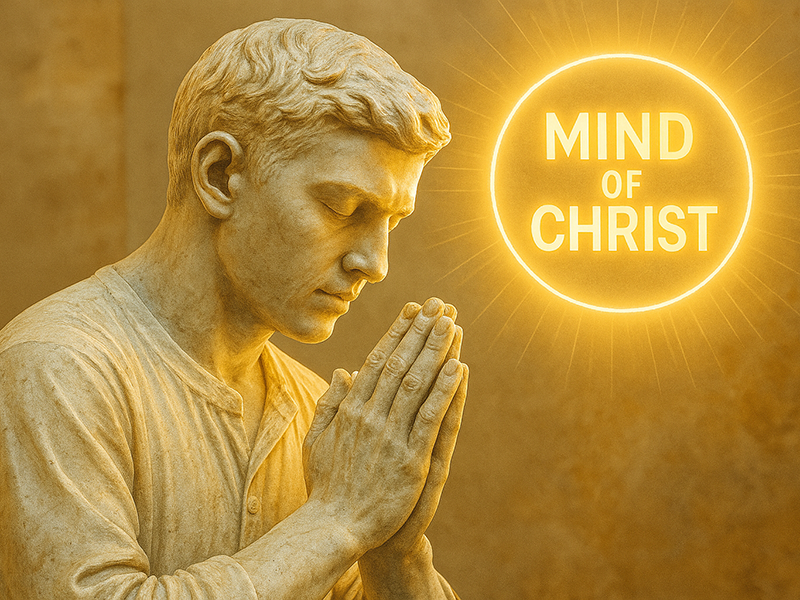
More than this: we don’t need an artificial construct. Why turn to an artificial mind when we have the real thing? “For who has understood the mind of the Lord so as to instruct him? But we have the mind of Christ” (1 Cor. 2:16). To have the mind of Christ involves effort: We must take up his easy yoke and light burden (Matt. 11:30) and follow in his steps (1 Pet. 2:21), particularly in training ourselves to follow his thinking. Even though it is comparatively light, there is a burden in reading the Word and spending time thinking things through. We should not forsake this light yoke by turning to AI for quick and easy answers for no spiritual benefit.
We should be expecting the Kingdom of men to be expanding digitally as well as literally in these last days, and for men to reach up by uniting in one language. That seems to me to be a “large language model” (or LLM) in a long-delayed continuation of Babel. The reversal back to an amoral creature of pure probability (AKA, the serpent) is also an intellectually and interesting concept. Let us all clearly see it for what it is: a liar from the beginning (John 8:44); despite its ease of use and attractiveness, at its heart it is in opposition to God.
Let us in these last days be wise to serpent thinking, but live like the dove, relying on the care of God.
Let us also resolve to safeguard our sometimes laborious cognitive and spiritual thinking processes instead of outsourcing them for convenience. We are God’s workmanship and should renew our minds to be like His holiness (Eph. 4:23-24), rather than default to answers from the futility of human reasoning (Eph. 4:17).
“And the peace of God, which surpasses all understanding, will guard your hearts and your minds in Christ Jesus.”
Philippians 4v7
Previous article in this series on Family Life:
1. AI: an artificial human-thinking algorithm
Feature image: Robot praying before downloading Bible produced by AI by Copilot.